
This first article in our series explains what is proposed and why it matters. Later articles in the series look at REITs in detail and reflect on what can be done now.
The consultation runs until 20 January 2027, so there is still time to assess the impact and have a say.
What’s proposed
The government has confirmed it will replace sovereign immunity with a statutory tax status from 1 January 2029. It is now consulting on the detail. Under the proposals, for those currently with sovereign immunity:
- Income from UK land would come into UK tax, as would gains on UK land and certain property-rich vehicles (these are currently exempt)
- Interest and most dividends would stay exempt
- Sovereign investors would keep qualifying institutional investor status for most fund regimes, although restrictions would apply on the substantial shareholdings exemption on property-rich structures and, other than state-operated overseas pension funds, would not be eligible investors in exempt unauthorised unit trusts (EUUTs)
- Sovereign investors could also hold or control a REIT through a new sovereign REIT holding company, which would pay 15% corporation tax on gross PIDs
- Sovereign investors holding less than 10% of a REIT would not need the holding company and would be taxed in the same way as other non-resident investors, typically relying on treaty relief
- State-operated overseas pension funds would get their own status, with an exemption from tax on gains, but no defined treatment for PID income
- Sovereigns would need to apply for the new status, with HMRC accepting applications at least six months before the start date
- Gains on existing holdings would be rebased to market value at 1 January 2029, so gains built up before that date should stay outside the new charge, but it remains to be seen whether elections will be made available for any unrealised losses up to 1 January 2029 to be protected from rebasing (as we saw for non-resident capital gains changes from 2019)
- Otherwise, sovereign entities would be taxed as non-UK resident companies, at the 25% corporation tax rate
Figure 1 compares the two main routes. If a sovereign holds a REIT through the new holding company, the holding company would pay 15% on PIDs from 2029. If it holds through a transparent vehicle, such as a JPUT or partnership, it would pay 25% on income and gains. Today, the tax is nil in both cases.
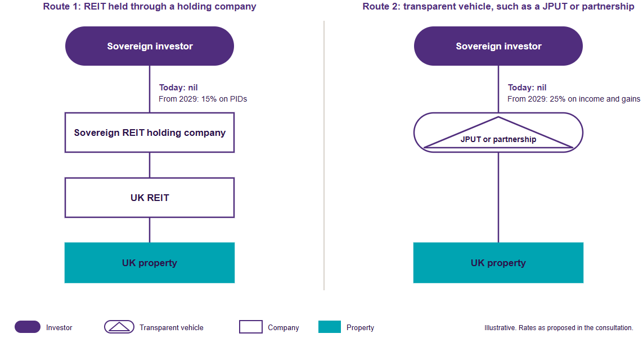
Figure 1: Tax on UK property income and gains for a sovereign investor, today and from 2029 (illustrative). Tax in Route 1 would apply at the sovereign REIT hold company level while tax under Route 2 would be charged on the sovereign investor itself.
Our headline view
In our view, the headline 15% rate that would apply to the PIDs that a new sovereign REIT holding company receives from UK REITs needs some care. The government describes 15% as the rate most UK tax treaties give non-resident investors on PIDs. But for many sovereigns that currently recover all tax withheld on PIDs, it would be a new and permanent cost. For some larger holders, it may be the only practical route to a reduced rate, as treaty rates can carry conditions that not every sovereign can meet.
Fund managers with sovereign investors are already asking how the 24% withholding rate on PIDs (from 6 April 2027) will interact with the 15% rate, and how the holder of excessive rights rules will now work. In simple terms, REITs generally withhold 24% from PIDs paid to non-resident investors. Those who can claim treaty relief recover the difference down to the treaty rate, while the holding company route instead pays 15% on the gross PID. We expect this to affect structuring in the lead-up to 2029. We can also see it prompting restructuring and early exit discussions across existing investment platforms.
Sovereign investors that hold UK property through tax transparent vehicles, such as JPUTs or partnerships, pay no UK tax on that income today. Under the proposals they would be taxed as non-UK resident companies, at 25% corporation tax on their share of income and gains. This will represent a material increase in the tax cost built into their return models, and so such investors may revisit their structuring options, including the REIT, if continuing to invest in the UK.
Moving to a REIT structure brings operational demands that investors in tax transparent vehicles may not have been exposed to, including compliance matters associated with UK residence where it is required under the REIT or sovereign REIT holding company structures.
Second time around
In 2022, the government at the time proposed bringing sovereigns’ UK property income and gains into tax. The proposals met strong opposition from the market, and at Spring Budget 2023 the government dropped them.
At Autumn Budget 2026 the government revived reform of sovereign taxation. It keeps the core principle of the 2022 proposals, reducing the exemptions available to sovereign investors, but the mechanics have changed. The sovereign REIT holding company option and separate treatment for state pension funds are new proposals this time round. The government is now also proposing an SDLT relief for restructuring and a longer runway between consultation and the rules coming into force, which may be a reflection of feedback and concerns raised in respect of the 2022 proposals.
The proposals are forecast to raise nearly £700 million a year once in force. The government has had time to reflect on responses to the earlier consultation, and the proposals look more considered, with a clearer sense of the intended end state.
Striking the balance
The proposals sit within a wider balance. They will raise revenue, but the UK also needs inbound investment in housing, infrastructure and commercial property. Sovereign investors are among the largest sources of long-term capital. They can choose where to invest, and will weigh the UK against other markets.
On the government’s own international comparison, most major European economies already tax foreign states on real estate income. Most still exempt some investment income. At 25% corporation tax, or 15% through the REIT route, the proposed UK position is arguably not out of line. Sovereigns will, though, look at the overall return, including treaty relief, rather than headline rates alone. The real question may be whether detail and complexity create friction that tips decisions at the margin.
Who qualifies
Currently, HMRC decides case by case whether an entity shares the state’s immunity. It looks at factors such as the entity’s founding law, control, capital and who owns its income. A legal entity that is separate and distinct from the government does not generally qualify. That is so even if the state owns all of it.
The proposals replace that judgement with a list. Eligible persons would include, among others, sovereign wealth funds and other wholly state-owned entities incorporated and resident in the home state. Constituent territories of federal states, and state-operated pension funds and their wholly owned vehicles, would also qualify. Some investors that struggle to qualify today would come within the new status. Equally, some that qualify today on a holistic view may not fit the formal tests.
Every sovereign investor, and every vehicle owned by one, should check where it lands well before applications open.
Beyond REITs
Not all sovereign investment in UK real estate is through REITs. Sovereigns investing through JPUTs, partnerships or other transparent vehicles would have no 15% route. As noted above, they would be taxed at 25% on their share of income, and on gains when they dispose of their interests.
For some, a move into a REIT may become worth considering despite the conditions, such as the holding company having to be UK tax resident, wholly owned by the sovereign and used only to invest in REITs. Conversely, for some investment models, the REIT wrapper would continue not to be an appropriate or desirable structure and so proactive review of pros and cons of structuring alternatives and exemptions and reliefs is always advisable. Funds and other owners should identify any sovereigns holding through transparent vehicles or vehicles which require tax exempt investors (including EUUTs), as they face the biggest change.
Questions to ask now
Before the detail settles, a few early questions will show how exposed your structures are:
- Which of your investors are sovereign wealth funds, state pension funds or entities they own?
- Does any sovereign hold, or could it hold, 10% or more of a REIT, counting connected entities?
- Do any sovereign investors hold through JPUTs, partnerships or other transparent vehicles, or vehicles reliant on their exempt status?
- Do you hold UK property directly, or alongside a sovereign in a joint venture?
- Are exits, refinancings or restructurings planned before or after 1 January 2029?
What comes next?
In Part 2, we look at what the proposals could mean for sovereign investors in a REIT, with worked numbers behind the 15% rate. In Part 3, we set out the questions the consultation leaves open, the points we are considering for our response and the key steps to take now.
Key dates for your diary
| Date | What happens |
|---|---|
|
20 January 2027
|
Consultation closes
|
|
6 April 2027
|
Withholding on PIDs rises to 24%
|
|
2027
|
Securities Transfer Tax replaces stamp duty and stamp duty reserve tax
|
|
2028
|
Proposed SDLT relief for restructuring opens, running to at least 31 December 2030
|
|
By mid-2028
|
Applications for the new sovereign status open, at least six months before the start date
|
|
1 January 2029
|
New regime starts, with gains rebased to market value
|
Key terms
- Real estate investment trust (REIT): a UK company or group that has elected to be exempt from corporation tax on its property rental business, subject to meeting certain conditions including that it must distribute most of those profits to investors.
- Property income distribution (PID): a distribution by a REIT out of its tax-exempt property rental profits or gains.
- Sovereign REIT holding company: the proposed new company through which sovereign investors could hold or control a REIT. It would pay 15% on gross PIDs.
- Holder of excessive rights: a company entitled to 10% or more of a REIT’s distributions, shares or voting rights. PIDs paid to it can trigger a tax charge on the REIT.
- Qualifying institutional investor: investors such as pension schemes, life assurance businesses, charities, sovereign investors and certain widely held funds. They receive favourable treatment under several regimes.
- Substantial shareholdings exemption: an exemption from corporation tax on gains when a company sells a substantial shareholding. A wider version applies to companies owned by qualifying institutional investors.
- State-operated overseas pension fund: the proposed category for state pension and social security funds.
- Exempt unauthorised unit trust (EUUT): a type of unit trust that is exempt from UK tax on its income and gains, provided its investors are all of certain tax-exempt types. Under the proposals, sovereign investors (other than state-operated overseas pension funds) would no longer be eligible investors.
- Jersey property unit trust (JPUT): a Jersey unit trust commonly used by investors to hold UK property.
- Rebasing: treating an asset as if it had been acquired at its market value on a set date (here, 1 January 2029), so that only gains arising after that date are taxed.
- Tax transparent vehicle: a vehicle, such as a partnership, whose income and gains are taxed on its investors rather than on the vehicle itself.
How we can help
Our real estate tax team works with REITs, fund managers and their investors on structuring, REIT compliance and stamp taxes. If you are, or invest alongside, a sovereign investor in UK real estate, please speak to us before 20 January 2027. We can help you model the impact, review your structure and prepare a consultation response.
Authors
-

Hugo Powell
Real Estate Tax Partner at Grant Thornton, advising investors, funds, developers and asset managers on acquisitions, disposals, restructurings, REITs, fund structures and stamp taxes. Specialises in real estate and infrastructure transactions, including build to rent, student accommodation, hotels, flexible offices and renewable energy projects.View Profile -

Matthew Stannard
I am a partner in the firm’s real estate tax team and regularly advise private equity houses, institutional investors, and listed real estate groups on all types of real estate transactions, including acquisitions, take privates, joint ventures, disposals, restructurings and IPOs.View Profile