Managing assets through Local Government Reorganisation

By: Wayne Butcher
11 Aug 2026 7 min read

Local Government Reorganisation is under way, with new unitary authorities expected to go live from April 2028. Amid the focus on governance, finance and workforce, asset management risks becoming an afterthought. Property and land portfolios are among the most material and complex elements of any reorganisation – carrying significant balance sheet values, long-term contractual obligations, compliance risks and community expectations. Getting this wrong is costly and difficult to unwind after vesting day. A clear message from our research is that authorities should build a shared picture of the estate, make strategic decisions before vesting day, and use technical property expertise throughout the process rather than as late validation.
What our audit work tells us
The current wave of LGR is the most extensive restructuring of English local government in a generation. A typical county area holds hundreds of operational assets across multiple predecessor councils. When those councils dissolve, every asset, liability and contractual obligation must transfer correctly to the successor unitary. Our VfM audit work across eight unitaries created since 2019 consistently found:
- compressed transition timescales, leaving too little time to build a complete picture of inherited assets before vesting day;
- optimistic capital receipt assumptions based on historic book values rather than realistic market assessment;
- balance sheet disaggregation left too late; and
- councils with strong asset data and a clear corporate landlord model before vesting day markedly better placed than those without.
Know what you have: data and the balance sheet
The foundation of effective asset management through LGR is a shared, accurate picture of the estate. The LGA identifies a complete, reconciled asset register across all predecessor councils as the single most important first step. In practice this is harder than it sounds: councils use different systems, coding structures and valuation methodologies, and some assets are held by wholly owned companies or informally held without clear documentation.
Valuation and the balance sheet split
Agreeing the balance sheet split between predecessor councils – allocating property, plant and equipment, reserves and capital financing – is technically complex and frequently contentious. It must be agreed during transition and supported by audited accounts. From April 2025 the CIPFA Code requires a revaluation cycle every five years, with indexation in intervening years, so councils must ensure valuations are current and applied consistently before balances are split. Where a legacy county council is involved, particular care is needed around the disaggregation of capital financing and Minimum Revenue Provision (MRP).
Make strategic decisions before vesting day
The most common mistake in LGR asset management is treating it as a simple aggregation exercise. The successful property strategy for a new unitary is not the sum of its predecessors – it is the creation of an entirely new, efficient portfolio.
Strategic Asset Management Plan
Every new unitary needs a Strategic Asset Management Plan (SAMP) from day one. The SAMP should identify which assets are operationally essential and which are surplus, set the headquarters and operational hubs strategy, rationalise the capital programme, and capture regeneration and housing opportunities from surplus land. Capital receipt projections should be stress-tested against realistic market conditions rather than book values.
Some decisions can be taken before vesting day regardless of the final structure. Examples include commissioning condition and compliance surveys across predecessor estates, agreeing an asset freeze on material disposals and new leases, establishing data-sharing protocols between predecessor councils, rationalising near-duplicate assets where the strategic logic is clear, and agreeing which LATCo entities transfer to which successor council.
LGR may also be the optimal moment to implement a robust corporate landlord model, centralising asset control within a single property function rather than allowing service departments to manage their own space. Its terms of reference, financial charging mechanisms and operating procedures should be foundational to the new council's structure, not added later.
Managing assets effectively in the new unitary
Effective ongoing asset management requires clear governance, the right systems, sufficient professional capacity and a coherent approach to performance and compliance. Councils that neglect this after vesting day risk drifting back toward the fragmented, service-led arrangements LGR was designed to replace. The key building blocks are:
- Governance and accountability – a dedicated corporate property function with a named Director or Head of Property reporting to the Chief Executive and Cabinet, an Asset Management Board with cross-directorate representation, clear delegated authorities, and strong political ownership of difficult closure and disposal decisions.
- Performance and condition management – a rolling five-year asset review covering condition, utilisation and value for money, a funded planned maintenance programme prioritising safety-critical works, and utilisation data to challenge departmental space-holding.
- One Public Estate and wider collaboration – engaging with the One Public Estate (OPE) programme to reduce the total public sector footprint and generate receipts, using collaboration opportunities created by the new unitary geography (this is more likely to apply in some areas than others).
- Community Asset Transfer – identifying CAT candidates before vesting day, with a clear policy framework and a realistic assessment of receiving organisations' capacity, recognising that the English Devolution and Community Empowerment Act 2026 strengthens community rights over Assets of Community Value.
- Legal transfer – all property, rights and liabilities transfer to the successor unitary under the Local Government (Structural Changes) Regulations, with particular care needed on restrictive covenants, trust and charity obligations, PFI and long-term contracts, and grant clawback conditions.
Subsidiary organisations: investment, delivery and the LGR question
Many predecessor councils have established Local Authority Trading Companies (LATCos), housing companies, development vehicles and special purpose entities to support commercial activity, housing delivery and asset management. LGR creates an immediate question about what happens to these entities, and how a new unitary should use subsidiary organisations to support its investment and delivery ambitions.
The landscape: what predecessor councils typically hold
A two-tier county area is likely to include a range of subsidiary entities accumulated across predecessor councils, often with overlapping purposes and varying commercial maturity.
Typical types include:
- housing delivery companies;
- property and development vehicles;
- facilities management / LATCo trading companies;
- energy and renewables companies; and
- regeneration and place vehicles, including joint ventures.
New councils must address:
- which successor council (where there are multiple) inherits which shareholding, and on what basis;
- whether the strategic rationale for each entity remains valid within the new unitary's portfolio and financial strategy;
- whether governance arrangements — board composition, shareholder oversight, dividend policy, performance reporting — are fit for a larger and differently structured parent;
- whether entity boundaries, geographies or remits need to change to reflect the new footprint; and
- what guarantees, loans or financial commitments were made to subsidiary entities, and how these transfer.
A new unitary inheriting a portfolio of subsidiary entities has an opportunity to rationalise and refocus them around a coherent investment and delivery strategy. This means considering the type of vehicle required and their specific considerations. For example, the revaluation of land transferred at below-market value, development pipelines that cannot simply be paused, affordable housing and grant obligations, Right to Buy and Housing Revenue Account (HRA) implications, change-of-control clauses in JV agreements, appropriate capitalisation, and a consolidated view of financial exposure for the Section 151 Officer. LGR is an opportunity to set out clear shareholder principles so that any retained or new entity is strategically necessary, financially sustainable and properly governed.
Key risks and next steps
Our audit work identified overly optimistic capital receipt assumptions as a recurring theme in unitary business cases. Assets earmarked for disposal frequently encounter real-world obstacles – planning constraints, contamination, heritage designation, structural issues or community opposition – and transition costs are real. The Institute for Government has cautioned that savings from LGR may take longer to materialise than business cases assume, so benefits and costs should be treated symmetrically. The principal risks to manage are:
| Risk area | What to do |
|---|---|
|
Capital receipt assumptions
|
Base these on specialist valuation, not book value. Stress-test against planning and market risk, and model the timing of receipts.
|
|
Compliance backlogs
|
Audit fire safety, asbestos, legionella and electrical certification across all predecessor estates before vesting day.
|
|
Commercial estate
|
Review inherited investment portfolios – income, condition and strategic fit for the new organisation’s risk appetite.
|
|
PFI and legacy contracts
|
Map all PFI obligations and assess transfer to successor(s), using Local Partnerships guidance for structured preparation.
|
|
Subsidiary exposures
|
Quantify all loans, guarantees and contingent liabilities to LATCos and JVs across predecessors.
|
|
Grant clawback
|
Identify assets subject to grant conditions or clawback provisions and assess transfer implications.
|
Next steps: a phased timeline
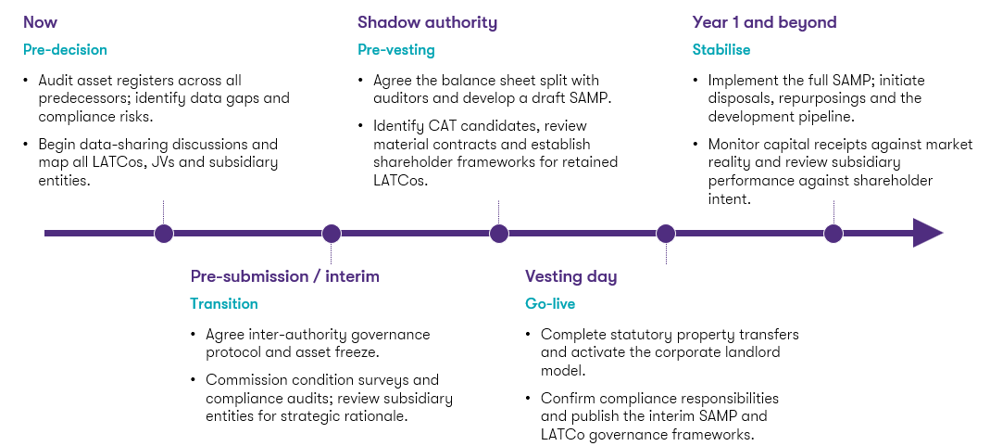
Asset management priorities move through five broad phases from now to the first year of the new unitary:
How Grant Thornton can help
Grant Thornton has supported local authorities through multiple waves of LGR. Our public sector team brings together advisory and assurance expertise to provide integrated support across the full LGR journey — from asset data and balance sheet split advice, through SAMP development and corporate landlord design, to business case stress-testing, compliance risk assessment, and LATCo, subsidiary and joint venture reviews.
Read more on our Local Government Reorganisation insights hub: Local Government Reorganisation. To discuss what LGR means for your assets, please contact Rob Turner or Wayne Butcher.
Authors
-

Wayne Butcher
I am a director in our public services advisory team and a financial adviser to local authorities, public sector bodies and private sector investors.View Profile