
AI has a ceiling most teams have not hit yet. Getting a good answer fast is easy – a great one, built for the long term, needs a different approach. Enterprise-level adoption requires time, investment and specific skillsets that not all teams may have access to.
To understand where tax functions stand today, we brought 43 tax leaders together this summer at our Central and South regional tax forums, polling the room on their current use of AI, the barriers holding them back, and what they plan to prioritise over the next 12 months.
How tax functions are using AI
AI handles ambiguous inputs to produce structured outputs. PDF invoices, legal agreements, or a set of meeting notes can be turned into something usable.
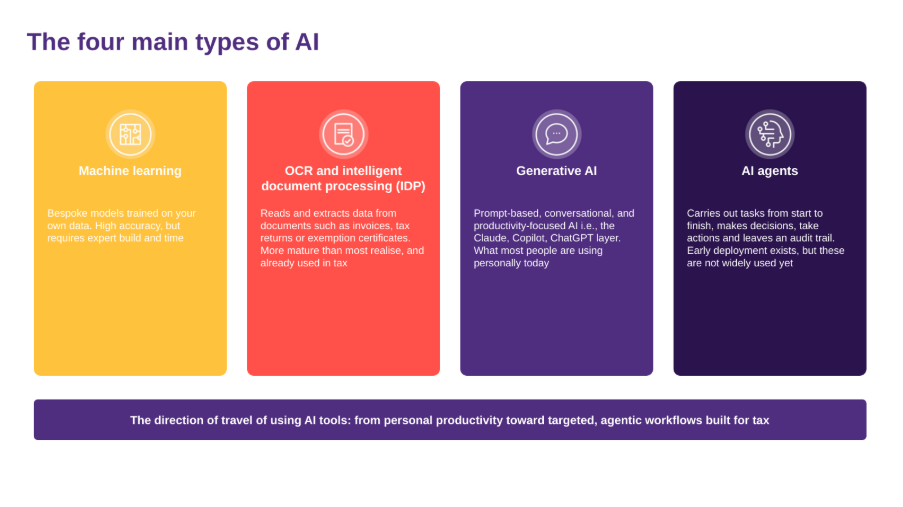
Across the tax lifecycle, AI is being used alongside automation to deliver the most value for tax functions across the three areas below:
- Tax data entry and processing: extracting information from unstructured documents, cleaning and formatting data, linking across systems, and populating forms that standard tax software does not support
- Tax data analysis and classification: analysing large volumes of tax data, surfacing patterns and anomalies, and classifying transactions and assets to support faster, sharper review
- Intelligent tax guidance and decision support: helping tax professionals make informed decisions using data, context and precedent, with AI grounded in company-specific data and historical outcomes
What we are seeing
A global retail business built its own AI ‘skill’ to perform Indirect Tax payments forecasting. The tool ingests historic VAT return data and current business forecast financials and returns the forecast VAT payments for the next period, learning more each time it processes return data.
Most tax teams sit between ‘Foundational’ and ‘Emerging’ on our AI maturity scale and are using AI tools primarily for productivity. 85.3% of attendees told us they already use general AI tools (e.g., Copilot or ChatGPT) informally. None reported AI being embedded across multiple parts of the tax lifecycle. Over the next 12 – 24 months, we expect most tax functions to experiment and try to move up the scale; however, we see a gap between intent and progress, with few likely to move past ‘Emerging’
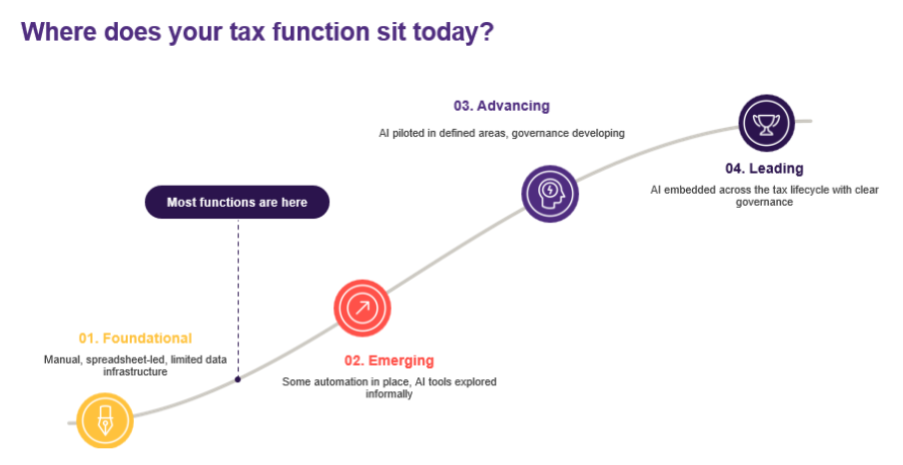
Which best describes your current use of AI in the tax function?
Combined poll results, Central and South regions. “Which best describes your current use of AI in the tax function?”
Data is holding tax functions back
Upgrading AI tools won’t move functions to ‘Advancing’ on its own; reviewing data is key before this.
Without consistent, complete and accurate data – regardless of the AI tools used – outputs will be unreliable. Most heads of tax in the room stated that they have work to do in at least one of these areas. Looking ahead 12 months, data quality and infrastructure topped the list of constraints (47.1%), ahead of budget and resource (29.4%). Then, when asked about what their primary data hurdles were, 54.5% pointed to data quality and consistency issues, with a further 24.2% citing siloed data.
Data is holding tax functions back
Upgrading AI tools won’t move functions to ‘Advancing’ on its own; reviewing data is key before this.
Without consistent, complete and accurate data – regardless of the AI tools used – outputs will be unreliable. Most heads of tax in the room stated that they have work to do in at least one of these areas. Looking ahead 12 months, data quality and infrastructure topped the list of constraints (47.1%), ahead of budget and resource (29.4%). Then, when asked about what their primary data hurdles were, 54.5% pointed to data quality and consistency issues, with a further 24.2% citing siloed data.
Biggest constraint on moving up the maturity scale in the next 12 months
Combined poll results, Central and South regions. “Thinking about the next 12 months, what is the single biggest constraint on moving your tax function up the maturity scale?”
What is the biggest data barrier to AI adoption in your tax function?
Combined poll results, Central and South regions. “What is the primary data hurdle to AI adoption in your tax function?”
Practically this means that data readiness must come before AI adoption, not alongside it. Data cleansing cannot be treated as a one-off project – it must be an ongoing control, because AI amplifies errors as much as it amplifies insight.
Governance and controls can often be seen as slowing adoption down; however, these are what make long-term adoption sustainable. Functions getting the most from AI put these in place early:
- Assign clear ownership
- Ensure human review
- Build testing into your process
- Monitor on an ongoing basis
- Maintain an audit trail
- Ensure appropriate data access controls
The tax landscape is moving forward
It is worth zooming out from the room itself. HMRC's 2026 Transformation Roadmap confirms it is investing heavily in AI, automation and the data platforms that underpin them; its own reporting states that AI and analytics contributed to protecting and recovering £10 billion in tax during 2025/261. This means data quality is not just becoming an inefficiency issue but a risk one.
Grant Thornton view
With HMRC increasingly using AI to flag inconsistencies, tax functions should prioritise accuracy from the outset. Investing in AI tools and strong data governance processes will help get it right the first time.
Where to start
Embedding AI and automation is more resource- and time-intensive than it may first seem, and there is a lot of ground to cover to get to ‘Advancing’ – we can help you get there. A few practical starting points drawn from the room and our own work with tax functions:
- Diagnose first: Know where you sit on the maturity scale as this will guide your next steps
- Prepare data foundations: Map data sources and define requirements before committing to a build
- Prove using pilots: Pick one or two priority use cases, focusing on areas of highest repetitive effort or greatest data volume for quick wins
Move faster on tax AI
We work with tax functions to map where they sit on the maturity scale, agree governance guardrails, and build a first AI and automation use case roadmap. If you would like to test where your function sits against this benchmark, or talk through what AI adoption means for you, please do get in touch. We run structured half-day sprint workshops to help you move forward at pace and maintain momentum.
[1] HMRC, Transformation Roadmap: update 2026; HMRC, Annual report and accounts 2025 to 2026
Get in touch
-

Gil Oglesby
I thrive on optimising processes and solving problems, helping tax leaders and their teams improve both what they do and how they do it.View Profile -

Sudiksha Kapoor
Business Consulting and Strategy | ACMA CGMA