In today’s cost-cutting economy, businesses frequently underestimate the significance of benefits tracking as part of their business planning cycle. Too often, we see transformation leaders struggling to gain transparency around the benefits of their transformation – a fundamental for performance visibility. But why is that the case, and how can leaders tackle and overcome the challenges around effective benefits management?
Why should you care about benefits?
Robust benefits management can be as critical to your organisation’s growth as cost management, and is essential to ensure a healthy, sustainable margin.
In the first instance, benefits identification provides a mechanism and framework for defining and categorising the benefits of a change or transformation. This provides greater assurance that transformation and change designs closely align with organisational objectives and strategy.
Quantifying benefits helps to steer thinking in mapping out the projected benefits realisation path. This allows for easier tracking and greater visibility during business cycle planning, timing and phasing.
Tracking benefits also elevates commercial visibility, empowering you to make better-informed decisions through analysis. And it can help identify underperforming projects and programmes, allowing for timely resolution and the opportunity to course-correct.
Finally, benefits quantification and tracking makes it possible to link programme performance to individual performance. Linking rewards and incentives to transformation benefits generates better focus, momentum and motivation. In addition, it incentivises individuals who might not have a role post-transformation to deliver against the plan.
Four barriers to managing and measuring benefits
If managing and measuring benefits is so fundamental, why do so many firms fail to execute it properly? We've identified four areas where issues commonly arise:
1 Capacity and capability
Experience tells us that the failure to implement effective benefits management lies in capacity constraints, timing misalignment and competency issues. Benefits management is challenging to execute and it can often be overwhelming knowing where to start or whether to embark on this journey at all.
2 Finance partnering
Part of any transformation journey is timely partnering with finance. This ensures that transformation has a seat at the table during key financial planning and budgeting cycles, and that transformation-related phased costs and benefits are accurate and provide a strong basis against which to track. Tracking against these provides the necessary metrics to inform future business decisions, reflecting on past successes.
3 Tangible versus intangible
Businesses assume – wrongly – that intangible benefits are unable to be defined and tracked. You need to think innovatively around the indirect impacts of your transformation, such as greater loyalty or employee satisfaction, measured through an improved Net Promoter Score or employee retention rates. You may not be able to directly attribute these to the change, but year-on-year analysis of this data will help you tell the story behind the drivers.
4 Strategic business planning
Businesses often attempt to expedite business transformation by rushing to deliver benefits, ignoring the interdependency between benefits management and strategic business planning. Designing and implementing a robust benefits management process with long-term strategic context in mind is needed in order to drive sustainable transformation.
We frequently partner with clients throughout this process and have outlined our step-by-step guide to prompt your thinking in this area.
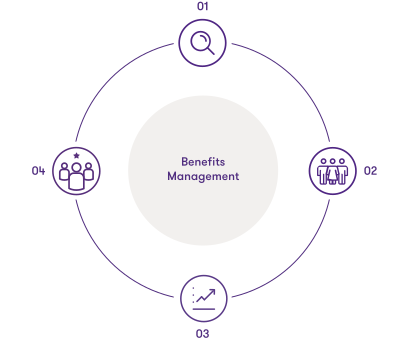
Benefits management – a high-level guide
![Diagram illustrating benefits management numbering accompanied by icons.]()
1 Benefits identification
Identifying benefits of a transformation or change, including defining and categorising them by financial, tangible, intangible, direct, indirect, etc. Upskilling of your colleagues may be required here.
2 Strategic consideration
All benefits need to be mapped and measured to ensure that they are aligned to your wider strategy and in managing your wider portfolio. Strong benefits tracking will help you to understand each benefit’s contribution to your business value.
3 Benefits management governance
Establishing the governance that underpins the entire benefits management process, providing the tools and framework for driving accountability while providing necessary check and challenge.
4 Benefits realisation tracking
Using the correct tools and governance cadence, track benefits to provide clarity as to whether you are realising benefits in line with your original expectations. The path forward is more readily available as a result of better analysis.
Transformation success
For leaders tasked with guiding and setting up an organisation for long-term success, it's integral to start taking benefits management seriously and not to underestimate the importance of measuring and managing the benefits of the changes you make. It can be the difference between transformation success or failure.
For more insight and guidance, get in touch with Camilla Williams.
Reimagine, design and deliver your transformation goals with us
Learn more about how our Transformation consulting services can help you