The structural flaw in housebuilders’ corporate funding

By: Ian Guthrie
23 Nov 2026 9 min read

Walk through the finances of a growing number of the UK’s private housebuilders and the same tension emerges. The balance sheet typically reveals a business with significant real assets: land in various stages of planning, work-in-progress (WIP) on active sites and an increasing proportion of finished stock. But the income statement tells a different story: earnings falling sharply as sales volumes soften, margins being compressed by sustained cost price inflation across labour and materials, rising interest costs and, importantly, these factors collectively eroding senior interest cover levels.
However, these contrasting pictures describe the same business: one that appears well-capitalised on paper but in practice, is unable to sustain the development activity it had delivered previously.
Housebuilders have responded, as any financially rational actor would, by slowing land acquisition, preserving cash, and cutting build rates to match what local demand can absorb. Each of those decisions makes sense in isolation. Collectively though, the result is a housebuilding industry producing fewer homes not just today but, because of the lag effect, for several years to come.
The balance sheet does not tell the whole story
The divergence between asset values and earnings is not coincidental. It is structural and reflects the fundamentally different timescales on which the two measures operate:
- Land and WIP accumulate gradually, built up over years of planning, site preparation and delivery before they translate into completions and revenue, so net asset value grows steadily through the cycle.
- Earnings are a different matter, and are driven by completions, sales rates and the margins available once build costs are accounted for. They can deteriorate sharply when market conditions tighten. A developer with a well-assembled land bank can therefore report a stable land and WIP book while earnings fall 30 or 40 percent in the same year.
When these two measures diverge, neither provides a reliable picture in isolation:
- Asset-based assessments can overstate realisable value where the demand needed to convert those assets into completions is absent.
- Earnings-based analysis can equally understate resilience where a high-quality development pipeline underpins the balance sheet.
Understanding the sector properly requires reconciling asset value, earnings capacity, return on capital employed and debt serviceability. In a distressed cycle, however, cash conversion is king.
A sequence that compounds
When earnings weaken and interest cover deteriorates, the funding models typically adopted by traditional lenders apply greater scrutiny to undrawn facilities and access is reduced, even where the underlying asset coverage has not materially changed.
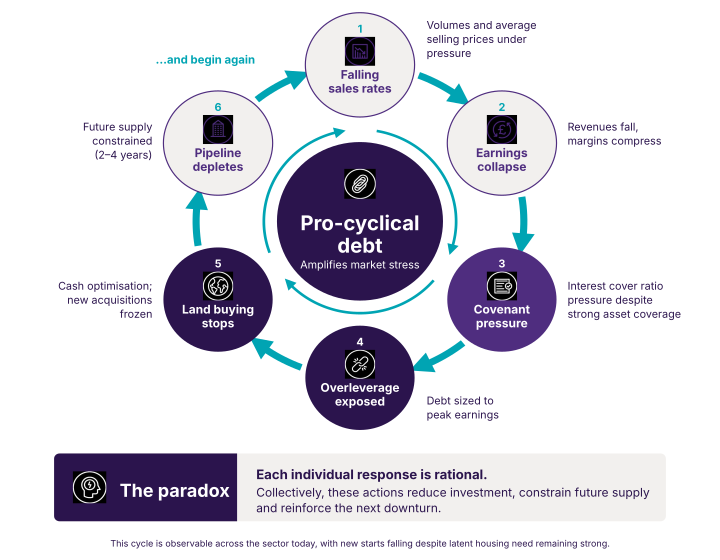
A sequence of decisions then follows with a degree of inevitability: developers stop acquiring land, new starts decline and the pipeline depletes. The level of housing supply two to four years from now is, to a significant extent, already being determined by the investment decisions being made – or deferred – today.
Investment contracts when conditions are most challenging, but the impact on supply arrives later, often when market conditions have stabilised or begun to recover. The pipeline shortfall cannot be resolved quickly, because the land assembly, planning consents and site preparation deferred during the downturn were not progressed. The costs are also distributed asymmetrically. Developers and traditional lenders each act rationally, yet the cost is borne by households through reduced housing availability and sustained affordability pressure.
When rational decisions create irrational outcomes
Pro-cyclical debt turns sensible management actions into a self-reinforcing cycle that suppresses future housing supply.
The role of debt
Conventional debt structures and covenants can amplify this cycle considerably. Corporate facilities are typically sized when earnings are strong, covenant headroom is comfortable and lender appetite is supportive. For example:
- At an all-in senior debt cost of 8% and a 2.0x minimum interest cover covenant, maximum sustainable debt is approximately 6.25x EBITDA. For a developer generating around £5m of EBITDA at peak, that implies capacity of around £31m.
- At mid-cycle earnings of £2.5m, that falls to approximately £16m.
A facility sized to peak conditions does not erode gradually as earnings normalise. It breaches quickly, typically when the developer most needs access to undrawn funding to maintain site activity and protect the pipeline.
The correct anchor for sizing is therefore mid-cycle rather than peak-year EBITDA. Better still, that sizing should be paired with a lower interest cover test of 1.0x and greater reliance on asset cover. If earnings then fell to a trough of £1.5m, a £16m facility would still cover interest around 1.2x, so it stays in place through the downturn rather than breaching.
The land and WIP book provide genuine asset coverage throughout the cycle, a real floor against loss for traditional lenders and investors. But that coverage does not generate funding capacity. A floor, however solid, does not fund a site. Nor does the project-level development finance secured against those assets provide a counter-cyclical alternative, as this too is withdrawn or repriced as conditions deteriorate: the same pro-cyclicality, one layer down.
The problem is further compounded by a divergence in how the same business is assessed by different capital providers. Equity investors and sponsors focus on returns and hold-period performance, while traditional lenders providing corporate facilities typically focus on interest cover and downside protection. In a sector where margins are cyclically compressed, these two frameworks can pull in opposite directions, and neither consistently supports the investment needed to sustain housing output through the cycle. Lacking access to the public equity markets, private housebuilders feel this tension particularly acutely in the bilateral corporate banking relationships on which they typically depend.
What the sector is already doing – and why it is not enough
Housebuilders have not been passive in responding to these pressures. Multi-tenure partnership models have grown considerably in importance, with relationships with Registered Providers of Social Housing (RPs) evolving well beyond the traditional section 106 obligation. Many programmes are now structured as forward-funded delivery arrangements, under which the RP commits to purchase an agreed proportion of scheme output ahead of or during construction. The terms are not as attractive as open market sale as margins are lower, but the commercial logic is clear. The build programme is de-risked by a committed purchaser at a known price, and progressive milestone payments generate early cash receipts that reduce peak debt and improve scheme viability.
Developers are also working more with build-to-rent platforms. Three-way tenure splits (dividing site output between build-to-rent, open market sale and affordable tenures) are gaining particular traction as a means of spreading demand risk across different capital sources.
These are sensible and rational adaptations that have improved resilience but not volumes. They do not resolve the underlying structural issue: a more cautious, capital-preserving sector is also a lower volume producing sector, and the adaptations that protect individual developers from covenant pressure are precisely those that constrain aggregate housing delivery.

“The pressures on UK housebuilders are being amplified by a structural flaw in the way corporate funding facilities are built across the sector. Calibrated to a different point in the cycle, these facilities tighten precisely when conditions deteriorate and access to funding is critical.
Almost every housebuilder with corporate funding lines is affected in the same way. As earnings fall and interest cover headroom erodes, they are left with no alternative but to downsize and prioritise cash generation, at the expense of investment in land and work in progress. Lenders place relatively little weight on the asset coverage sitting behind those facilities, even though it typically remains robust throughout.
This is exactly the kind of challenge we work through with clients at Grant Thornton, from restructuring existing facilities to bringing in funding built to stay in place through the cycle. We understand the issues facing UK housebuilders and we are here to help.”
A different approach to debt
The issue is not with debt itself, but the way conventional debt, typically provided by high street lenders, is structured:
- Facilities sized to peak earnings, with interest cover covenants calibrated to favourable macro conditions, behaves pro-cyclically. They expand when developers least need them and contract when they most do.
- What the sector needs is less debt at the peak in exchange for debt that stays in place, with interest cover covenants calibrated to sustainable mid-cycle earnings, carrying maturities aligned to the development timeline, and not subject to terms that compel withdrawal in a downturn.
In England, the National Housing Bank, working in partnership with commercial lenders, is well positioned to provide this, or to support others to provide it through co-lending alliances that avoid the conventional pitfalls. Such debt can be sized against sustainable earnings, structured with longer maturities that reflect the two-to-four-year lag between land acquisition and completions, and deployed counter-cyclically rather than withdrawn when conditions deteriorate.
The objective is not to replace the commercial lending market but to complement it, providing structural stability alongside existing specialist development finance, and helping ensure the housing pipeline is sustained through the cycle.

“We work with SME developers across the country and see first-hand how access to finance can change as market conditions shift. Where some corporate lenders may have less appetite for development finance, that leaves good developers with viable schemes facing fewer funding options.
Paragon takes a different approach, grounded in specialist development finance expertise and close relationships with our clients. This means we assess each scheme on its individual merits and understand the challenges developers are facing. That relationship-led approach is increasingly important in a more challenging and uncertain market.
It’s an area we’re looking at closely and one where we want to do more over the next year. As developers navigate continued economic uncertainty and a difficult and complex operating environment, there is a clear role for specialist lenders like Paragon to provide the consistency, expertise and appetite needed to help viable schemes move forward.”
Conclusion
The UK housing challenge is consistently framed as a planning problem, a land availability problem or a demand problem. All of those are genuinely important, but they can be compounded by corporate debt structures that amplify the cycle, reducing funding capacity at precisely the moments when investment most needs to be sustained, embedding a multi-year lag between decisions made during a downturn and the supply shortfall that follows.
Private housebuilders hold the assets, understand the sites and absorb the risk. An industry characterised by steady asset accumulation, volatile earnings and pro-cyclical corporate debt structures will struggle to deliver consistent housing output if the conditions under which those assets can be reliably converted into homes are not maintained through the cycle.
That is the structural problem, and it is not one that planning reform alone can solve.
Get in touch
-
Ian Guthrie
I lead our real estate advisory practice. I'm a high-performing, strategic, and innovative senior leader with over 35 years’ experience, having overseen more than £30 billion of complex financial transactions across real estate, private equity, financial services (particularly banking) and the public sector.View Profile