As of April 2025, announcements have included a 10% baseline tariff on almost all foreign imports, additional higher tariffs on most Chinese goods, and several sector-specific tariffs. Global businesses will be affected by impacts such increasing production costs and sales changes. Businesses must quickly understand the relationship between their processes, and the rapidly evolving socio-economic and political environment, in order to adapt and maintain resilience.
Tariffs are just one of a number of risks to businesses in an increasingly uncertain world. These range from those posed by geopolitical tensions such as the Russia-Ukraine conflict, major global shocks such as the COVID-19 pandemic, and other macroeconomic issues such as inflation and recession, cyber security threats and the impacts of climate change.
By overlaying different types of information with company data and through the process of scenario analysis, insights can be gained into these risks, and used to inform planning and investment decisions, pricing decisions, and risk mitigation actions.
This type of analysis is of particular importance to companies looking to invest in different jurisdictions, or with supply chains spread over jurisdictions where the political, regulatory and policy landscape are especially uncertain. It can be both backward and forward-looking, for example as part of due diligence or strategic investment planning. A forward-looking assessment may involve testing the impact of specific risk factors on cash flow forecasts and understanding how these values may change over time to appraise strategic options.
While companies may be aware of some of the risks they face at a high level, using relevant company and wider contextual information provides the opportunity to go further and carry out comprehensive scenario analysis.
Implementation in practice – a case study
We’ve constructed a hypothetical ‘case study’ as an example of how company specific and wider contextual information could be used to carry out scenario modelling for a hypothetical global steel manufacturing company.
Company name: STLfoundries Limited
Company type: Steel manufacturer
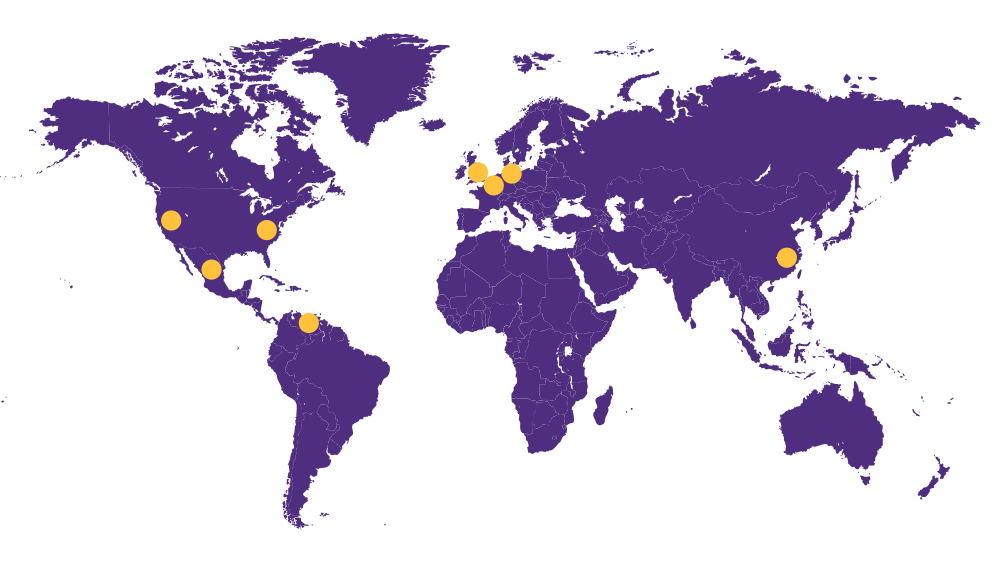
Site locations:
- Mining sites: US and China
- Steel mills and plants (core production facilities): US, China, Mexico, Venezuela, UK and Germany
- Distribution centre: Belgium
- Headquarters: UK
![]()
Figure 1: Location of STLfoundries Limited sites
Risk assessment: the macroeconomic impacts of political decisions such as tariff imposition
Each of STLfoundries sites are exposed to a range of unique external socio-economic risks. One of these risks is the economic risk associated with political decision making, e.g. through the impacts of tariffs and sanctions. It is possible to assess the impacts of tariff imposition on the company under different scenarios by considering the potential impacts of varying tariff rates and interacting variables such as demand changes, currency fluctuations and economic growth rates.
Taking the current situation as of 10 April 2025, the US has imposed a baseline tariff of 10% on most goods imported to the US including from the UK, as well as a 25% tariff on aluminium, steel and derivative good imports, passenger vehicles and automobile parts from the UK. China has a tariff rate of 145% on most Chinese goods; in response China have applied 84% tariffs on US imported goods. Tariffs may affect STLfoundries by:
- Impacting sales: Tariffs on steel exported to the US and other involved countries could change the competitive environment and disrupt sales to key markets. STLfoundries may decide to attempt to pass this increase in cost on to customers. The impact on future revenues will depend on the sensitivity of demand for steel products to price increases, the competitive position of the company and exchange rate changes.
- Increasing production costs: The imported raw steel and other components that are subject to tariffs may result in lower profit margins if the company doesn’t pass on these costs down the supply chain.
The potential impact of tariffs on cash flow forecasts can be tested using scenario modelling and sensitivity analysis to adjust variables and observe the impact on business revenues, costs and overall financial performance. This forward-looking scenario analysis can be an effective tool for assessing the potential impact of different tariff rates on the company’s financial performance and informing strategic decisions.
The steps that would be involved in this empirical analysis are set out below:
- Define relevant tariffs: Determine which tariffs the company’s operations are exposed to. In the case of STLfoundries this would include tariffs on steel exports to the US, as well as any imports to China from the US, including intermediate imports within the supply chain.
- Gather data: Collect historical data on previous tariff rates, trade volumes, prices and other relevant economic indicators to identify the historic relationship between tariff rates and other economic variables. Analysis of market reports, industry trends and competitor behaviour can help to understand how different tariff scenarios may affect the steel industry as a whole.
- Develop scenarios: Develop a range of appropriate scenarios that reflect different tariff rates and associated changes in demand, currency fluctuations and economic growth rates.
- Model impacts: Model the impact of each scenario on key financial metrics such as revenue, costs, profit margins and cash flow. This will involve adjusting sales prices based on increased costs due to tariffs, estimating changes in sales volume resulting from pricing changes and calculating changes in cost structures due to increased import prices. Sensitivity analysis will need to be conducted to determine how different variables (eg changes in sales volumes or costs) affect the outcomes of each scenario.
- Analyse results and develop strategic responses: Compare results under each scenario to identify potential risks and opportunities. This may include understand the impact of different tariff rates on profitability, how competitive positioning may shift based on changes in pricing and the identification of potential supply chain vulnerabilities and alternative sourcing strategies. Based on the analysis, the company can develop contingency plans and strategic responses for each scenario.
The economic and political landscape should be monitored for changes in tariff policies and trade agreements, in order to update the scenario analysis as new information becomes available or as company strategy evolves. A similar scenario analysis could be carried out for other risk factors that can affect business processes, ranging from other socio-political risks to climate risk. Analysis can also include testing of how these variables may change over time.
Why does this matter?
There are benefits to companies of understanding and qualitatively and quantitatively assessing risks and carrying out scenario analysis that extends beyond compliance. These arise from companies being able to demonstrate resilience, increased understanding of risks under potential scenarios and future-proofing their operations and supply chain, all of which help to maintain a competitive edge. Specifically, this might include:
- Being aware of the socio-economic and political context your business operates in, identifying trends, risks and opportunities, measuring impacts quantitatively and qualitatively, and adapting your strategy as needed.
- Opening up your supply chain as others in your supply chain may be assessing their own risks and looking to set their own targets and demonstrate compliance. Being able to provide this information to them is likely to become increasingly important.
Learn more about how our Economic consulting services can help you
Getting support
Our Economic Consulting team can help you to understand wider risks to your company and carry out scenario analysis on your business forecasts. We can model a range of risks under multiple scenarios and help to identify risks at all stages of your supply chain.
For advice, or guidance relating to such analysis, get in touch with Tom Middleton.