

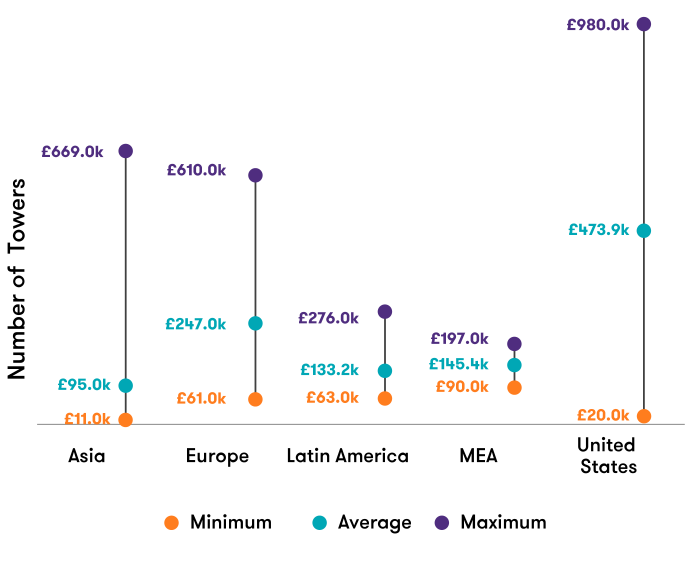
Figure 1: Enterprise Value/Tower (USDk) multiples since 2015
So, what is important in valuing telecom towers? Value drivers boil down to the same fundamental considerations as for almost any other asset: growth, risk and return on invested capital.
1 Growth potential in telco towers
Growth potential is the key value driver – increasing the number of sites and/or getting more equipment onto those sites.
Network coverage and densification
Tower portfolios generate revenue by leasing space on the structures to their customers (MNOs and others). Organic lease revenue growth comes from two main areas – an increase in the number of towers (coverage) and an increase in the amount of tenants’ equipment sited on the towers (densification).
High multiples have been achieved partly as a result of 5G requirements (additional/larger antennas) and partly due to rural coverage obligations of existing MNOs, which continue to drive network roll-out and growth.
Infrastructure sharing
Growth for independent towercos is being underpinned by the trend for outsourcing tower infrastructure. Increasing the number of customers siting equipment on each tower is the main growth driver behind the high multiples being paid in Europe by Cellnex, American Towers and others. Strong technical diligence is needed to evaluate this lease-up potential, however.
The split between ground-based towers and rooftops, as well as the make-up of the ground-based towers, split between lattices, guyed, monopoles, stealthed, etc., are just some of the factors that influence capacity considerations.
New market entrants
Towerco revenue growth can be turbocharged by the entrance of new operators. In Italy, for example, new market entrant Iliad is pushing tower revenue growth rates for Inwit beyond baseline organic growth, as it rolls out its network using Inwit’s towers. The merger creating Inwit implied a 24x EBITDA multiple, which partly reflected that opportunity.
Expanded services
Tower investors seek a range of risk/return opportunities. Some are comfortable with the low growth but dependable income streams associated with the core towers business, while others seek higher returns from new services such as fibre to the tower, small cell or distributed antenna system businesses. Without new revenue opportunities from additional types of services, it may be hard to justify some of the higher multiples seen in some European deals recently.
Customer mix
Customer mix is linked to growth, maturity of services and ease of market entry. For example, tower deals involving a mix of broadcast and telecoms towers typically attract lower multiples compared with pure telecom tower portfolios because the future of broadcast is seen to be under challenge from digital technologies and online streaming.
2 Risk factors in tower investments
Tower investments generally carry less risk than investments in downstream retail telcos. This is due to the long-term, contractual nature of their cash flows and high barriers to entry, but the following factors may affect the volatility of tower cash flows (and therefore risk):
Anchor tenants
Tower investments carry significantly less risk (and therefore higher valuations) where they come with an anchor MNO tenant, as is typically the case with sale-and-leaseback transactions. From an investor’s perspective, this reduces risk significantly as it guarantees a revenue stream from an existing anchor tenant, and potentially further contractual commitments for build-to-suit (BTS) extensions of the tower network in accordance with the MNO’s coverage plans. Contracts may also incorporate price escalators (inflation links) and share risks associated with above inflationary cost increases for key cost elements, further de-risking a deal.
On the flip side, anchor tenants often have priority rights which may limit other growth opportunities. There is also likely to be downward pressure on lease pricing at contract/MSA renegotiation, as MNOs’ margins/profits are always under pressure.
Despite the savings that can be delivered through towercos, the rental of space on towers still makes up a large part of an MNO’s expenditure. It is, therefore something that MNOs will seek to target/reduce wherever possible. Notwithstanding these points, unless the anchor tenant is seen as a financial risk, it is generally positive in valuation terms.
RAN sharing and MNO consolidation
RAN (radio access network) sharing and MNO consolidation result in fewer needed ‘points of service’ and hence a reduction in towerco revenues. Both trends are likely to continue as markets become more competitive.
Regulatory risk
Unlike the telecoms sector more generally, tower infrastructure has not been subject to heavy regulation so far. Regulation in developed markets has mostly focused on ensuring site aesthetics, environment protection and, more recently, promoting collocation.
High growth, developing markets may involve a greater degree of regulatory and political uncertainty, however. Tower valuation multiples in developing market deals have tended to be significantly lower despite higher market growth potential. This risk is typically captured in the form of country risk premia, which push up discount rates in discounted cash flow valuations.
Legal risk
Establishing legal title to the tower sites is crucial. The longevity of the site leases and issues around lease renewals impact value. There is also a risk that landowners may choose not to renew or extend leases – although this can also bring an opportunity to renegotiate more favourable terms.
The degree of flexibility and sharing of risk embodied in agreements, especially in sale-and-leaseback deals, is another important area of legal diligence. Favourable legal terms can transfer risk away from the tower owner and lock in cash flows for longer. Conversely, unfavourable terms can reduce flexibility and expose the tower owner to risk from price changes in key lease or supply contracts.
Barriers to entry
A portfolio with a higher proportion of rooftop towers versus freestanding towers would usually attract a lower valuation because the barriers to entry for competing infrastructure are lower. It is often cheaper, easier and faster to obtain planning permission for a simpler rooftop structure than a larger, free-standing tower. Higher value will be attached to towers that occupy unique positions with no competing options, which confer a competitive advantage in addressing coverage obligations.
Cost of capital
Listed tower businesses tend to have lower asset beta than listed telcos. This supports relatively low costs of equity. Stable, predictable cash flows also support low borrowing costs, meaning low overall costs of capital. In an environment of cheap money, the ability to finance acquisitions more cheaply than others has allowed some of the larger players to pay higher multiples.
3 Return on capital
Operating costs and CAPEX requirements vary significantly between tower portfolios, being important value drivers.
Quality of the asset base / capital expenditure
An investment in tower assets is an investment in physical infrastructure. The condition, capacity and quality of the assets themselves is an important value driver. A younger, well maintained tower portfolio in a more benign climate will tend to attract a higher valuation. A portfolio with significant capacity readily available in key locations is also worth significantly more than one with no capacity, or even with negative capacity, as is occasionally found on overloaded structures.
Technical due diligence will help determine the cost of accommodating additional equipment, and therefore the capital expenditure (CAPEX) and operating expenses (OPEX) associated with future revenue potential. Free capacity in both the site compound and shelter will need to be taken into account to support additional tenants.
Given the extent to which many deals’ growth expectations are dependent on adding additional and heavier equipment to existing structures – a key aspect of supporting 5G roll-out – a quality asset base will drive higher values.
Operating costs
The primary operating cost for a tower business is its rental or lease cost that it pays to site owners. Dealing with hundreds of landlords in a country where the legal and regulatory framework is not necessarily favourable to the towerco, increases costs and risk with a consequent drag on value.
Security is an important consideration, especially for rooftop sites. Poor security may also require significant additional CAPEX as well as ongoing OPEX spend. Security issues and site access challenges contributes to lower multiples in many developing countries.
Another significant operating cost is power. Portfolios where the majority of sites are connected to the electricity grid are far cheaper to run than those with sites where power has to be provided by generators, which in turn need to be refuelled and maintained by contractors.
Some operating costs, or increases in costs above agreed inflationary rates, can be passed through to customers contractually, reducing the risk of margin erosion. But this is not always the case.
Looking ahead
With significant investment activity expected in the European tower sector over the next few years, a good understanding of fundamental value drivers will be key to making sound valuation judgments in a very buoyant market.
Appropriate due diligence must inform DCF assumptions, with cross-checks to transaction benchmarks providing a useful sense check. To discuss these issues further, contact Adam Sutton.
