Equal Pay: Understanding and managing risks in local authorities
Learning programmesPractical e‑learning that helps local authority managers, HR teams and leaders identify, prevent and manage equal pay risks with confidence.


704 PFI / PF2 deals reached financial close between 1992 and 2016, with a combined capital value of over £57 billion. With the average operational period of a contract being around 28 years, expiry is due to peak in the coming years.
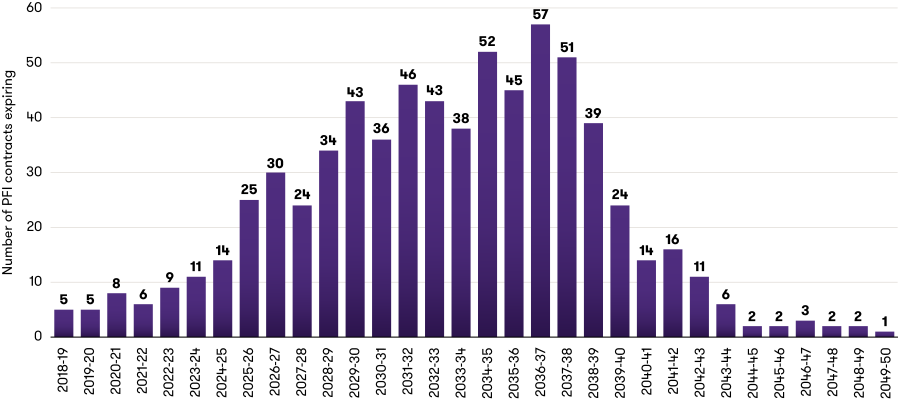
Data: Private Finance Initiative and Private Finance 2 projects: 2018 summary data - GOV.UK (www.gov.uk)
The Infrastructure and Projects Authority (IPA) expects senior leaders to commence planning for private finance initiative (PFI) expiry at least seven years prior to contract end.
37 of the PFI / PF2 deals cover waste services. Local authorities must act now to make the best decisions for the future of this provision:
Act too late and this could significantly reduce the opportunity to enforce the local authority’s rights and remedies under the contract (including potentially withholding unitary charges) and any potential claims identified post-expiry may not be recoverable if the project company’s assets have already been removed.
Of course, maintaining a positive and effective working relationship with the incumbent service provider is preferred and a robust communication strategy will assist with this. If desired, there could be the opportunity to extend the existing contract to allow more time to consider future plans and ensure a fully competitive process is developed – as this is the only way to ensure true value for money for council tax-payers.
The expiry of your PFI contract is complex, and sometimes daunting, but it's also an opportunity to refresh the approach to waste services in line with current legislation, societal trends, and evolving technology.
Asking some key questions can help you identify relevant considerations and potential next steps.
Footnote 1: Consistency in household and business recycling in England consultation feedback (from 896 respondents) currently being analysed with government response expected in 2023
We have worked on many of the original waste PFI contracts and are currently advising on the expiry and next steps for one which is due to expire before 2030. This deep understanding of the waste sector, our insight into government, and innovative approaches, will support you to bring ideas into reality.
Our waste specialists can draw upon expertise from across our firm (eg, financial modelling, tax, accounting, place-based analytics, economic consulting) as well as a network of partners to tailor our services to your needs. Our national reach ensures that we’re always local to your project.
For more insight and guidance, get in touch with Jennifer Brown.



Practical e‑learning that helps local authority managers, HR teams and leaders identify, prevent and manage equal pay risks with confidence.

Local Authorities enter 2026 still facing sustained financial strain. Despite uplifts in core spending power across the sector as a whole, pressures from social care demand, contract inflation and higher borrowing costs continue to erode resilience across the sector. Recent parliamentary evidence confirms that, whilst rare, the number of Section 114 notices issued since 2018 is at an all-time high, underlining the systemic nature of the challenge and the scrutiny on historic corporate investments and subsidiary performance.



Decarbonising the UK’s energy system and wider economy will require rapid electrification of heat, transport and industry, leading to a sharp rise in electricity demand. The National Energy System Operator’s (NESO) analysis suggests electricity demand could increase by 25-40% by the early 2030s and almost triple by 2050, reaching up to 700-785 TWh per year, compared with around 290 TWh today