Christopher McLean and Amit Bagga look at when and why mid-market borrowers should consider raising hybrid capital, which we see as an increasingly important source of funding as we move into 2023.
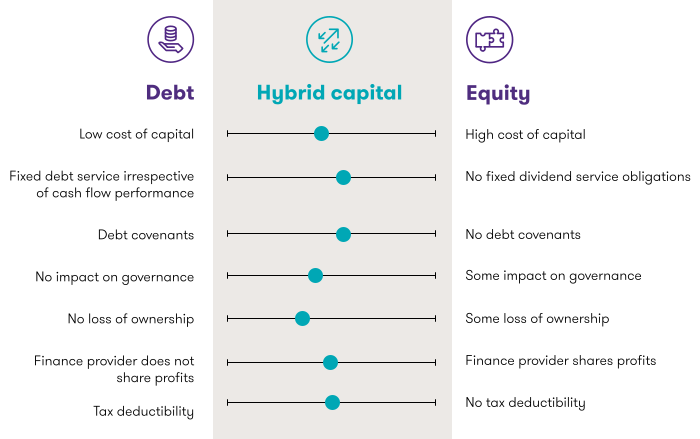
Hybrid financing structures combine elements of both debt and equity and can offer benefits to issuers which aren't provided by debt or equity alone. Sometimes referred to as intermediate capital, it can also be used by companies and shareholders who are considering private equity investment, but are not yet ready or want to achieve more scale first.
The advantages of debt translate to the disadvantages of equity, and vice versa, but hybrid capital can achieve a balance.
![diagram depicting the hybrid capital achieving balance]()
Why should mid-market borrowers consider hybrid capital?
Existing lenders more cautious
Businesses models are under pressure due to rising input costs, higher interest rates and reduced consumer confidence leading some sectors to experience reduced top line sales and significant margin pressure. Sectors under more pressure than others include, for example, manufacturing, hospitality, retail, and real estate. As some lenders look to protect their own balance sheet exposures, many are adopting a more discerning outlook, being more selective both with new lending opportunities, as well as participation in refinancings. Hybrid financing offers access to a new pool of capital, in addition to existing lenders. Borrowers also benefit from a diversification of their funding base, giving more financing options going forward.
Leverage constraints prevents issuance of more debt
Many firms are operating with increased levels of debt due to the necessity of borrowing to survive the pandemic. Existing debt facilities will include covenants which limit the amount of additional debt a company is able to take on and can constrain the type of financing available. Hybrid capital, with its equity-like features, can allow companies to access to finance which will not affect headline debt levels, and can improve a firm’s gearing (debt to equity) ratio.
Raise finance with reduced impact on operational cashflow
Raising debt impacts the operational cash flow of a business, as interest and principal repayments are fixed obligations that must be made – which will only increase with higher interest rates. Hybrid capital can be structured to reduce the impact on cash flow to enable a firm to cover financial obligations on an ongoing basis, with items such as a toggle between cash interest and accrued interest, and more flexible and sculpted amortisation schedules increasingly popular.
Maintain ‘firepower’ to take advantage of opportunities
By raising capital with equity-like features, firms can not only shore up their financial resilience, but retain firepower for their growth and acquisition strategy, enabling them to take advantage of opportunities that might arise in the market. For some, 2023 will be a year of many opportunities and the ability to act fast with committed financing in place will give such firms a real competitive advantage.
Steppingstone to raising private equity
Raising hybrid capital can be a useful stepping stone to raising private equity – bridging the gap until management believes they can achieve the right valuation in the market. It can also provide a clear future exit strategy for hybrid capital providers with the prospect of future private equity investors allowing hybrid capital providers to offer more attractive funding terms.
How Grant Thornton can help
Our debt advisory team can introduce companies to specialist and flexible lenders and investors who have a greater level of risk appetite and can support with innovative solutions such as hybrid capital when traditional sources may not be available or can't provide the flexibility needed. By engaging a carefully selected range of lenders and investors in a competitive process, we deliver the best deal the market has to offer for your business.
Visit our Capital Thinking hub to get insights from our UK debt advisory specialists, who can help you to navigate the complex lending landscape and wider debt markets.
For more insight and guidance, get in touch with Christopher McLean or George Fieldhouse