

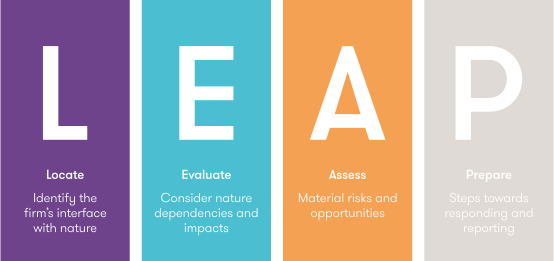
Locate:
1 Where are our direct assets and operations, and our related-value chain (upstream and downstream) activities?
2 Which biomes and ecosystems do these activities interface with? What's the current integrity and importance of the ecosystems at each location?
3 At which locations is our organisation interfacing with ecosystems assessed as being low integrity, high biodiversity importance and/or areas of water stress?
4 What sectors, business units, value chains, or asset classes are interfacing with nature in these priority locations?
Evaluate:
1 What are our business processes and activities at each priority location? What environmental assets and ecosystem services do we have a dependency or impact on at each priority location?
2 What are our nature-related dependencies and impacts across our business at each priority location?
3 What is the size and scale of our dependencies on nature in each priority location?
4 What is the size and scale of our nature impacts in each priority location?
Assess:
1 What are the corresponding risks for our organisation?
2 What existing risk mitigation and management approaches are we already applying?
3 What additional risk mitigation and management actions should we consider?
4 Which risks are material and should be disclosed in line with the TNFD disclosure recommendations?
5 What nature-related opportunities does this assessment identify for our business?
Prepare:
Strategy and resource allocation:
1 What strategy and resource allocation decisions should be made as a result of this analysis?
2 How will we set targets and define and measure progress?
Disclosure actions:
3 What will we disclose in line with the TNFD disclosure recommendations?
4 Where and how do we present our nature-related disclosures?
What can firms do now?
Firms should engage with the beta version and assess their capabilities with relation to the frameworks to identify gaps. While some may have not considered nature-related reporting yet, it's important to use the TNFD’s work as the foundation for future compliance.
The TNFD’s framework is the first step towards a global standard for nature-related reporting. Assessing the risk and opportunities around nature will only intensify – businesses should prepare sooner rather than later. This requires considerations around resource allocation and prioritisation.
You should explore the domestic regulatory focus on nature-related reporting and understand how this impacts governance, strategy, risk management and metrics and targets. Starting to map out the internal frameworks will push you in the right direction.
Firms can look to build on their response to TCFD. Consistency and harmonisation among different areas of ESG and sustainability is a key priority for all stakeholders, meaning you can leverage learnings across frameworks.
While risk is an essential part of nature-related reporting, there are also opportunities. Businesses can use this framework to push commercial decision-making towards more nature positive outcomes that improve their ESG positions.
Firms that start out early stand to gain the most, while those that fail to plan now may struggle to adapt in the future.
If you want to discuss nature-related reporting, biodiversity or any topics mentioned in this piece, contact Paul Young.