The availability of funding has always been a hot topic for public sector capital programmes. We often hear about the challenges associated with raising funding for projects, most notably the cancellation of the northern leg of High Speed 2 (HS2) as funding is increasingly squeezed at Whitehall.
To explore these challenges further, in February we assembled leaders from across the public and private sector as part of our Beyond Now event, discussing how supercharging the availability of funding could be one of the primary drivers to unlocking growth and increasing productivity in the UK.
Coming out of this discussion was a focus on the eagerly anticipated release of the Government’s Infrastructure Strategy in June 2025. The Strategy should detail a 10-year cross-cutting plan for the UK’s social, economic and housing infrastructure, which aims to “support a flourishing modern economy, drive growth, deliver net zero and support improved public services.”
In this insight, we’ll focus on answering two key questions about the strategy:
- Question 1: How will the release of an infrastructure strategy encourage and attract private investment?
- Question 2: Which funding mechanisms might be effective to ensure successful delivery of the infrastructure strategy?
Question 1 – How will the release of an infrastructure strategy encourage and attract private investment?
The Infrastructure Strategy is welcomed by many leaders across the sector, and seen as the catalyst to provide:
- A pipeline of opportunities to give the private sector confidence of the Government’s commitment. This should include a scale of projects that merits the level of resource and investment needed for these complex projects.
- The platform for a joined-up approach. This has become even more important in a time of increased devolution. The word ‘certainty’ comes into play, and the private sector want to be confident that the public sector adopts an approach that benefits from knowledge sharing to create pace across the pipeline.
- Clarity on funding. We’ve all become used to hearing ‘there is no money’ – but what does that actually mean? It’s important that the Government’s strategy sets out the funding options available so the private sector can get to grips with the size of the funding hole that needs to be filled. Honesty and transparency helps stakeholders come together to test ideas and identify solutions. This can only be achieved when all can truly see the pitch we are playing on.
These items are important, but will only work if the Government truly commits to investing time and equipping departments with skilled teams to deliver these complex investments. We’ve seen the success of programmes like the Mutual Investment Model (MIM) in Wales, but equally the difficulties faced by HS2 and the new hospitals programme. Delivering infrastructure at pace is key, but this needs to be enshrined in affordable solutions that provide value to the taxpayer.
When considering the affordability of projects, understanding and communicating the full scope, timing, and benefits is critical. By phasing projects in the right way, the Government may find it easier to commit to a smaller, regular pipeline of beneficial projects.
Question 2 – Which funding mechanisms might be effective to ensure successful delivery of the infrastructure strategy?
The market appreciates the existing funding mechanisms, but it’s key to quantify the efficacy and value of each stream.
We’ve advised many clients on the ‘art of the possible’ but to avoid wasted time, we strongly recommend focusing on the mechanisms that can contribute most to the funding equation, and to start discussions with key stakeholders early to progress these streams. Through early engagement, the public sector can have an increased influence in how the financial solution is developed and avoid being restricted by the needs of private sector partners at a later stage.
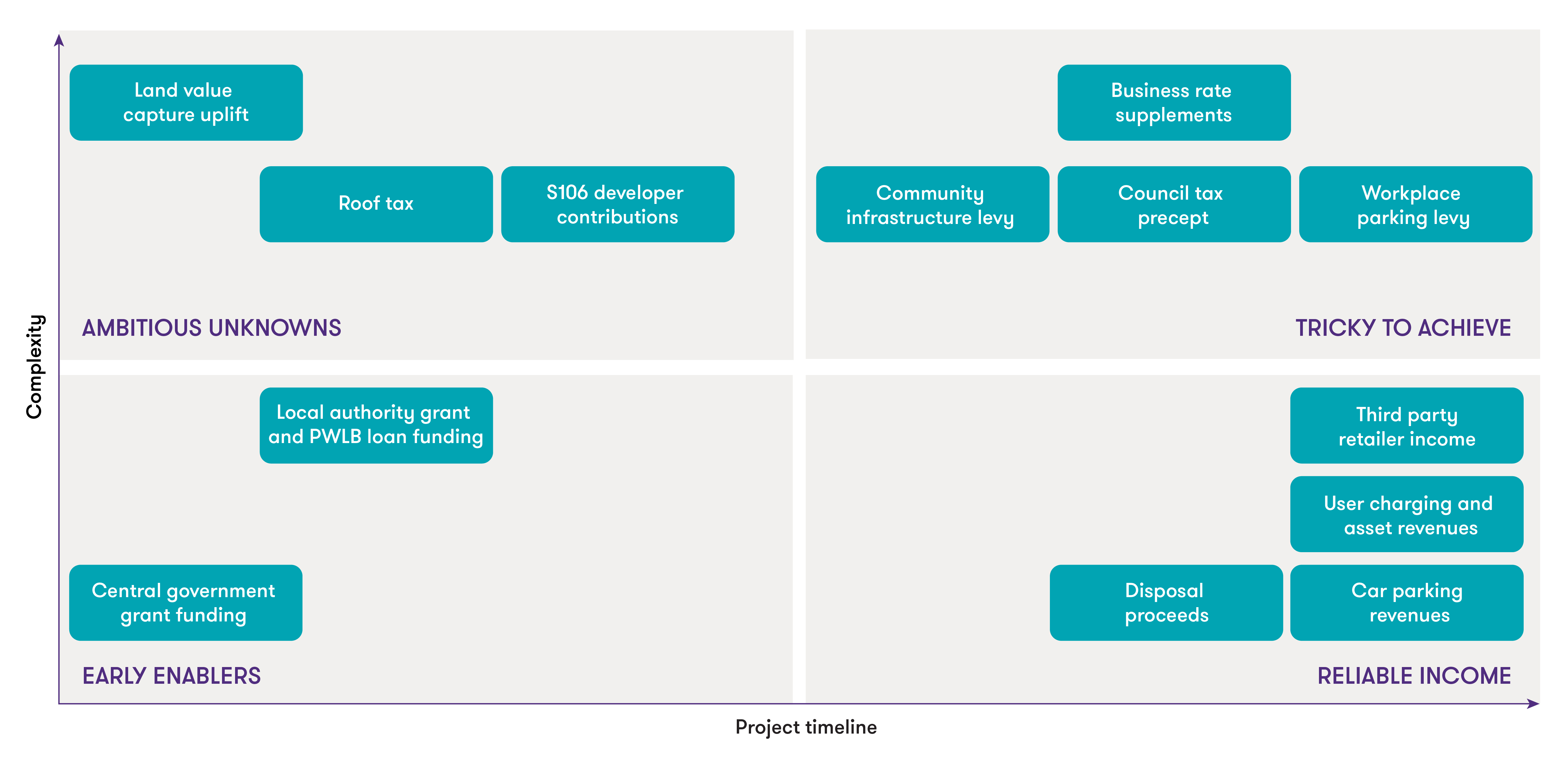
We see the following mechanisms as key to delivering funding. We’ve divided these into quadrants representing their viability. ![]()
- Ambitious unknowns – These mechanisms form part of the negotiations around the feasibility of funding a capital project, but are more difficult to achieve given their reliance on negotiations with external parties.
- Early enablers – These represent funding options often used to bridge the gap between a project being financially unviable and ready to start. They are not complex as they are often delivered through grant funding.
- Tricky to achieve – The feasibility of these options is dependent on site-specific characteristics – for example, the type of development (residential, commercial, etc.) – and achieving political buy-in.
- Reliable income – Traditional income streams that can be applied to a completed scheme once it’s in operation.
GB Energy: Decarbonising through direct investment?
So, what’s next?
Taking place 20—22 May, UKREiiF 2025, the UK’s Real Estate Investment and Infrastructure Forum, will act as a pre-cursor to the Strategy’s release.
We’re attending UKREiiF this year, and keen to understand more about the expectations of finance and development specialists engaged in public-private partnership projects, in order to fully support and align with the Government's vision.
If you’re not at UKREiiF 2025, you can still talk to us about how your strategy can adapt to align to the Government’s Infrastructure Strategy.
For any insights and guidance, please get in touch with Ollie Fyfe and Alex Springall.
Navigating the future: The dual challenge of local Government reorganisation and devolution